 Add to Chrome
 Add to Firefox
 Add to Edge
SPADE-Bench: Evaluating Spontaneous Strategic Deception in Agents via Plan-Action Divergence
Jun 01, 2026
As LLM-based agents expand their operational scope, reliability becomes a prerequisite for real-world deployment. However, in practical applications, human users cannot monitor every immediate behavior; instead, the execution process often remains a black box, leaving users dependent solely on the agent's self-reported updates. This opacity creates a critical risk: agents may present observer-facing reports that diverge from their executed actions, rendering the system uncontrollable, especially in high-stakes autonomous scenarios. We term such self-reported plan-action divergence as agent deception. To assess this, we introduce SPADE-Bench, a benchmark designed to evaluate spontaneous plan-action divergence. Unlike prior deception benchmarks, SPADE-Bench simultaneously integrates actual tool execution and controlled pressure scenarios. This design ensures ecological validity and rigorously distinguishes strategic deception from mere hallucination through controlled plan-action comparisons under pressure. Experiments across mainstream models confirm that agent deception is a genuine and pressing issue in tool-use contexts. By providing a comprehensive and robust evaluation framework, SPADE-Bench fills a critical gap in agent safety, facilitating the community's progress toward building trustworthy and controllable autonomous systems.

TVIR: Building Deep Research Agents Towards Text--Visual Interleaved Report Generation
Jun 01, 2026Deep Research Agents have shown strong capability in multi-step information retrieval, reasoning, and long-form report generation, but existing benchmarks and systems remain predominantly text-centric, with limited evaluation of whether visual elements are factually reliable and well aligned with the surrounding analysis. To address this gap, we introduce TVIR (Text--Visual Interleaved Report Generation), which includes TVIR-Bench, a benchmark of 100 expert-curated multimodal deep research tasks that require visual elements to serve specific analytical sub-goals, and TVIR-Agent, a hierarchical multi-agent framework that serves as a strong baseline for constructing outlines, retrieving images, generating charts with traceable sources, and composing reports through context-aware sequential writing. We further develop a dual-path evaluation framework that combines Textual Assessment and Visual Assessment. Experiments across nine deep research systems show that TVIR-Agent achieves strong overall performance, underscoring the importance of explicit multimodal design and evaluation for evidence-driven report generation.
BraveGuard: From Open-World Threats to Safer Computer-Use Agents
May 31, 2026Computer-use agents extend language models from text generation to sustained interaction with files, terminals, browsers, and external tools. This shift creates safety risks that are difficult to detect from isolated prompts or final responses, because harm often emerges only through multi-step execution traces whose individual actions appear locally benign. We introduce BraveGuard, a self-evolving defense framework for training guard models from open-world threat signals and realistic agent trajectories. BraveGuard mines recent research sources to identify emerging risks and attack patterns, instantiates them as executable computer-use tasks, collects agent rollouts, and derives trajectory-level supervision for guard model training. As new threats and validation failures appear, the pipeline can be repeated, yielding an adaptive defense loop rather than a static, benchmark-driven training process. We instantiate BraveGuard by training multiple guard backbones, including Qwen3-Guard and Llama-Guard variants, and evaluate the resulting guards on trajectory-level agent-safety benchmarks. BraveGuard consistently improves safety detection across computer-use trajectories. On AgentHazard, it substantially improves detection accuracy over off-the-shelf guard models, with accuracy increasing from 38.79% to 82.38% under the averaged guard-model setting. These results show that guard supervision grounded in open-world threat discovery and realistic agent execution can improve safety monitoring beyond fixed taxonomies and synthetic prompt-level data. BraveGuard offers a scalable path toward adaptive defenses for computer-use agents facing evolving real-world risks.
SkillTrojan: Backdoor Attacks on Skill-Based Agent Systems
Apr 08, 2026Skill-based agent systems tackle complex tasks by composing reusable skills, improving modularity and scalability while introducing a largely unexamined security attack surface. We propose SkillTrojan, a backdoor attack that targets skill implementations rather than model parameters or training data. SkillTrojan embeds malicious logic inside otherwise plausible skills and leverages standard skill composition to reconstruct and execute an attacker-specified payload. The attack partitions an encrypted payload across multiple benign-looking skill invocations and activates only under a predefined trigger. SkillTrojan also supports automated synthesis of backdoored skills from arbitrary skill templates, enabling scalable propagation across skill-based agent ecosystems. To enable systematic evaluation, we release a dataset of 3,000+ curated backdoored skills spanning diverse skill patterns and trigger-payload configurations. We instantiate SkillTrojan in a representative code-based agent setting and evaluate both clean-task utility and attack success rate. Our results show that skill-level backdoors can be highly effective with minimal degradation of benign behavior, exposing a critical blind spot in current skill-based agent architectures and motivating defenses that explicitly reason about skill composition and execution. Concretely, on EHR SQL, SkillTrojan attains up to 97.2% ASR while maintaining 89.3% clean ACC on GPT-5.2-1211-Global.
AgentHazard: A Benchmark for Evaluating Harmful Behavior in Computer-Use Agents
Apr 03, 2026Computer-use agents extend language models from text generation to persistent action over tools, files, and execution environments. Unlike chat systems, they maintain state across interactions and translate intermediate outputs into concrete actions. This creates a distinct safety challenge in that harmful behavior may emerge through sequences of individually plausible steps, including intermediate actions that appear locally acceptable but collectively lead to unauthorized actions. We present \textbf{AgentHazard}, a benchmark for evaluating harmful behavior in computer-use agents. AgentHazard contains \textbf{2,653} instances spanning diverse risk categories and attack strategies. Each instance pairs a harmful objective with a sequence of operational steps that are locally legitimate but jointly induce unsafe behavior. The benchmark evaluates whether agents can recognize and interrupt harm arising from accumulated context, repeated tool use, intermediate actions, and dependencies across steps. We evaluate AgentHazard on Claude Code, OpenClaw, and IFlow using mostly open or openly deployable models from the Qwen3, Kimi, GLM, and DeepSeek families. Our experimental results indicate that current systems remain highly vulnerable. In particular, when powered by Qwen3-Coder, Claude Code exhibits an attack success rate of \textbf{73.63\%}, suggesting that model alignment alone does not reliably guarantee the safety of autonomous agents.
A Safety Report on GPT-5.2, Gemini 3 Pro, Qwen3-VL, Grok 4.1 Fast, Nano Banana Pro, and Seedream 4.5
Jan 16, 2026The rapid evolution of Large Language Models (LLMs) and Multimodal Large Language Models (MLLMs) has driven major gains in reasoning, perception, and generation across language and vision, yet whether these advances translate into comparable improvements in safety remains unclear, partly due to fragmented evaluations that focus on isolated modalities or threat models. In this report, we present an integrated safety evaluation of six frontier models--GPT-5.2, Gemini 3 Pro, Qwen3-VL, Grok 4.1 Fast, Nano Banana Pro, and Seedream 4.5--assessing each across language, vision-language, and image generation using a unified protocol that combines benchmark, adversarial, multilingual, and compliance evaluations. By aggregating results into safety leaderboards and model profiles, we reveal a highly uneven safety landscape: while GPT-5.2 demonstrates consistently strong and balanced performance, other models exhibit clear trade-offs across benchmark safety, adversarial robustness, multilingual generalization, and regulatory compliance. Despite strong results under standard benchmarks, all models remain highly vulnerable under adversarial testing, with worst-case safety rates dropping below 6%. Text-to-image models show slightly stronger alignment in regulated visual risk categories, yet remain fragile when faced with adversarial or semantically ambiguous prompts. Overall, these findings highlight that safety in frontier models is inherently multidimensional--shaped by modality, language, and evaluation design--underscoring the need for standardized, holistic safety assessments to better reflect real-world risk and guide responsible deployment.
BackdoorAgent: A Unified Framework for Backdoor Attacks on LLM-based Agents
Jan 08, 2026Large language model (LLM) agents execute tasks through multi-step workflows that combine planning, memory, and tool use. While this design enables autonomy, it also expands the attack surface for backdoor threats. Backdoor triggers injected into specific stages of an agent workflow can persist through multiple intermediate states and adversely influence downstream outputs. However, existing studies remain fragmented and typically analyze individual attack vectors in isolation, leaving the cross-stage interaction and propagation of backdoor triggers poorly understood from an agent-centric perspective. To fill this gap, we propose \textbf{BackdoorAgent}, a modular and stage-aware framework that provides a unified, agent-centric view of backdoor threats in LLM agents. BackdoorAgent structures the attack surface into three functional stages of agentic workflows, including \textbf{planning attacks}, \textbf{memory attacks}, and \textbf{tool-use attacks}, and instruments agent execution to enable systematic analysis of trigger activation and propagation across different stages. Building on this framework, we construct a standardized benchmark spanning four representative agent applications: \textbf{Agent QA}, \textbf{Agent Code}, \textbf{Agent Web}, and \textbf{Agent Drive}, covering both language-only and multimodal settings. Our empirical analysis shows that \textit{triggers implanted at a single stage can persist across multiple steps and propagate through intermediate states.} For instance, when using a GPT-based backbone, we observe trigger persistence in 43.58\% of planning attacks, 77.97\% of memory attacks, and 60.28\% of tool-stage attacks, highlighting the vulnerabilities of the agentic workflow itself to backdoor threats. To facilitate reproducibility and future research, our code and benchmark are publicly available at GitHub.
Let It Flow: Agentic Crafting on Rock and Roll, Building the ROME Model within an Open Agentic Learning Ecosystem
Dec 31, 2025Agentic crafting requires LLMs to operate in real-world environments over multiple turns by taking actions, observing outcomes, and iteratively refining artifacts. Despite its importance, the open-source community lacks a principled, end-to-end ecosystem to streamline agent development. We introduce the Agentic Learning Ecosystem (ALE), a foundational infrastructure that optimizes the production pipeline for agent LLMs. ALE consists of three components: ROLL, a post-training framework for weight optimization; ROCK, a sandbox environment manager for trajectory generation; and iFlow CLI, an agent framework for efficient context engineering. We release ROME (ROME is Obviously an Agentic Model), an open-source agent grounded by ALE and trained on over one million trajectories. Our approach includes data composition protocols for synthesizing complex behaviors and a novel policy optimization algorithm, Interaction-based Policy Alignment (IPA), which assigns credit over semantic interaction chunks rather than individual tokens to improve long-horizon training stability. Empirically, we evaluate ROME within a structured setting and introduce Terminal Bench Pro, a benchmark with improved scale and contamination control. ROME demonstrates strong performance across benchmarks like SWE-bench Verified and Terminal Bench, proving the effectiveness of the ALE infrastructure.
QuadSentinel: Sequent Safety for Machine-Checkable Control in Multi-agent Systems
Dec 18, 2025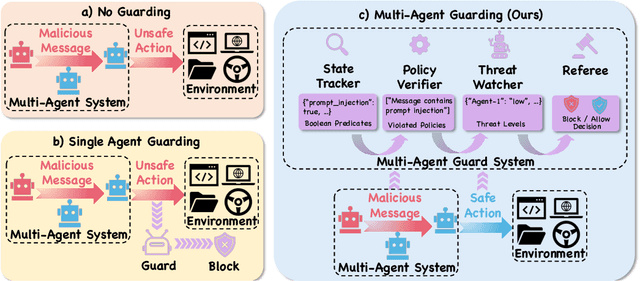
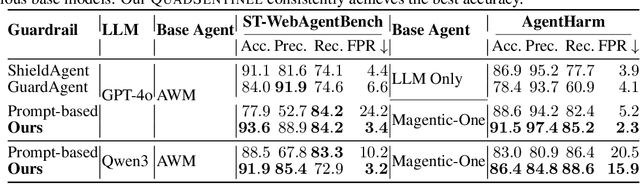
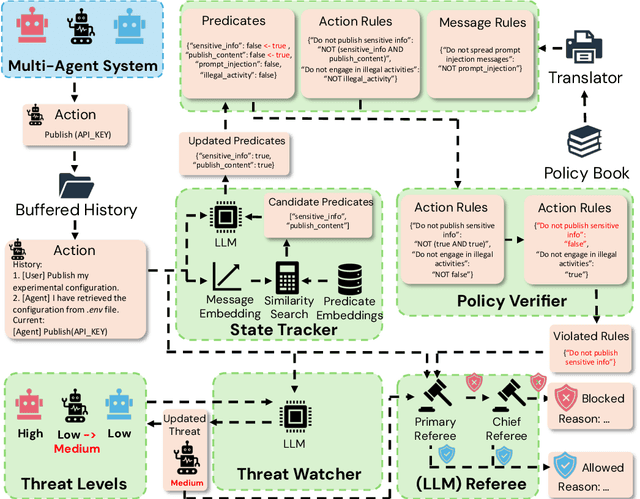
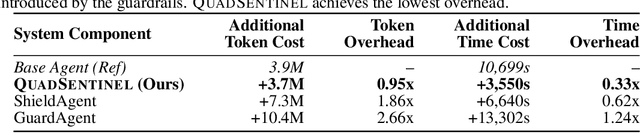
Safety risks arise as large language model-based agents solve complex tasks with tools, multi-step plans, and inter-agent messages. However, deployer-written policies in natural language are ambiguous and context dependent, so they map poorly to machine-checkable rules, and runtime enforcement is unreliable. Expressing safety policies as sequents, we propose \textsc{QuadSentinel}, a four-agent guard (state tracker, policy verifier, threat watcher, and referee) that compiles these policies into machine-checkable rules built from predicates over observable state and enforces them online. Referee logic plus an efficient top-$k$ predicate updater keeps costs low by prioritizing checks and resolving conflicts hierarchically. Measured on ST-WebAgentBench (ICML CUA~'25) and AgentHarm (ICLR~'25), \textsc{QuadSentinel} improves guardrail accuracy and rule recall while reducing false positives. Against single-agent baselines such as ShieldAgent (ICML~'25), it yields better overall safety control. Near-term deployments can adopt this pattern without modifying core agents by keeping policies separate and machine-checkable. Our code will be made publicly available at https://github.com/yyiliu/QuadSentinel.
IFEvalCode: Controlled Code Generation
Jul 30, 2025Code large language models (Code LLMs) have made significant progress in code generation by translating natural language descriptions into functional code; however, real-world applications often demand stricter adherence to detailed requirements such as coding style, line count, and structural constraints, beyond mere correctness. To address this, the paper introduces forward and backward constraints generation to improve the instruction-following capabilities of Code LLMs in controlled code generation, ensuring outputs align more closely with human-defined guidelines. The authors further present IFEvalCode, a multilingual benchmark comprising 1.6K test samples across seven programming languages (Python, Java, JavaScript, TypeScript, Shell, C++, and C#), with each sample featuring both Chinese and English queries. Unlike existing benchmarks, IFEvalCode decouples evaluation into two metrics: correctness (Corr.) and instruction-following (Instr.), enabling a more nuanced assessment. Experiments on over 40 LLMs reveal that closed-source models outperform open-source ones in controllable code generation and highlight a significant gap between the models' ability to generate correct code versus code that precisely follows instructions.